Ghost Forests: When Rising Salt Kills the Trees
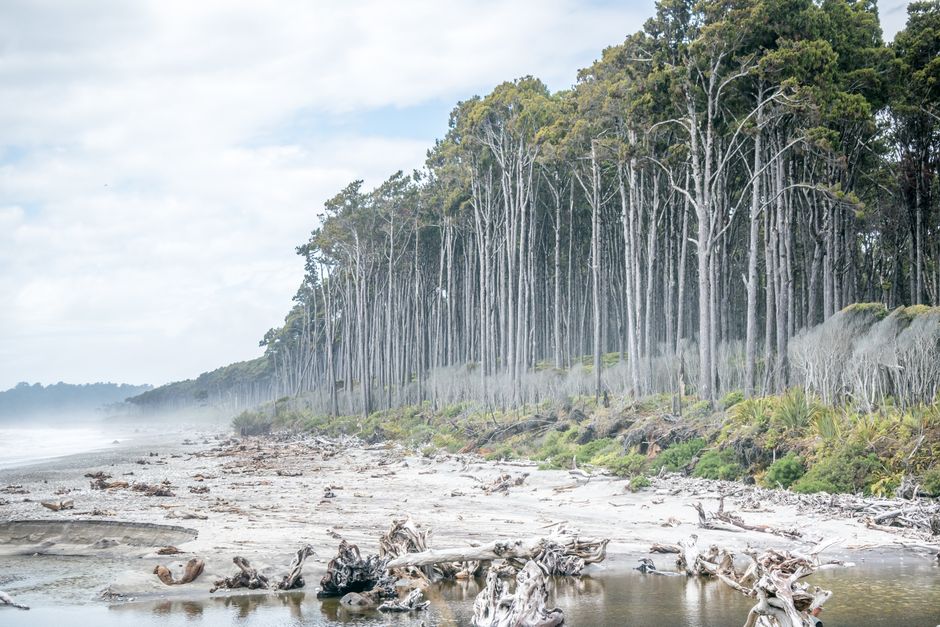
They look like something out of a ghost story. Tall, bare trunks rising out of the water or standing in mudflats where trees should not be. No leaves. No branches. Just gray snags against the sky. These are ghost forests, and they are spreading along the Atlantic and Gulf coasts as sea levels rise and salt water pushes inland.
The process is straightforward, even if the consequences are not. Coastal forests — typically made up of bald cypress, loblolly pine, sweetgum, and other freshwater-loving trees — sit on low-lying land just behind the marsh. As sea levels rise, salt water moves farther inland, either at the surface during storms and high tides or underground through the soil. The trees cannot tolerate the salt. Their roots fail. They die. And what was once forest becomes marsh, or open water, or a graveyard of standing dead wood.
A Slow-Motion Transition
Ghost forests are not new. The coast has always been shifting. Storms have always pushed salt water into places it does not belong. But the pace has accelerated. In many places, the transition from forest to marsh that might have taken centuries is happening in decades. The trees die faster than new marsh can form, leaving behind bare ground that erodes easily.
The visual is powerful — dead trees are hard to ignore — but the ecological changes are more subtle. As the forest dies, the birds and animals that depended on it lose habitat. Migratory songbirds that nested in coastal forests must find new places to raise their young. Amphibians and reptiles that lived in freshwater wetlands disappear. The soil chemistry changes. The food web shifts.
In some places, the dead trees themselves become habitat. Woodpeckers and other cavity-nesting birds use the snags. Ospreys build nests on the bare branches. But this is a temporary phase. Eventually the trees fall, and the marsh or open water takes over.
What Ghost Forests Tell Us
Ghost forests are one of the most visible indicators of sea-level rise. They are also a reminder that the coast is not a fixed line. It is a moving boundary, and it has always moved. The problem is that we have built our roads, our houses, and our farms right up to the edge, and in many places we have hardened that edge with seawalls and bulkheads. When the marsh tries to migrate inland, it runs into a wall.
Scientists study ghost forests to understand how fast the change is happening and where it is likely to occur next. They core into the soil to see what the land used to look like. They map the dead trees from satellites. They measure the salinity of the groundwater. The goal is not just to document the loss but to figure out where there is still room for the marsh to move.
For those of us who love the coast, ghost forests are hard to look at. They are a reminder of what is being lost. But they are also a call to action. If we want to keep the marshes and the forests that border them, we need to give them space to shift. That means protecting undeveloped land, removing barriers to migration, and planning for a future in which the coastline will not look the same as it does today.